
Chomsky, Grief, and the life of a Proletarian Academic

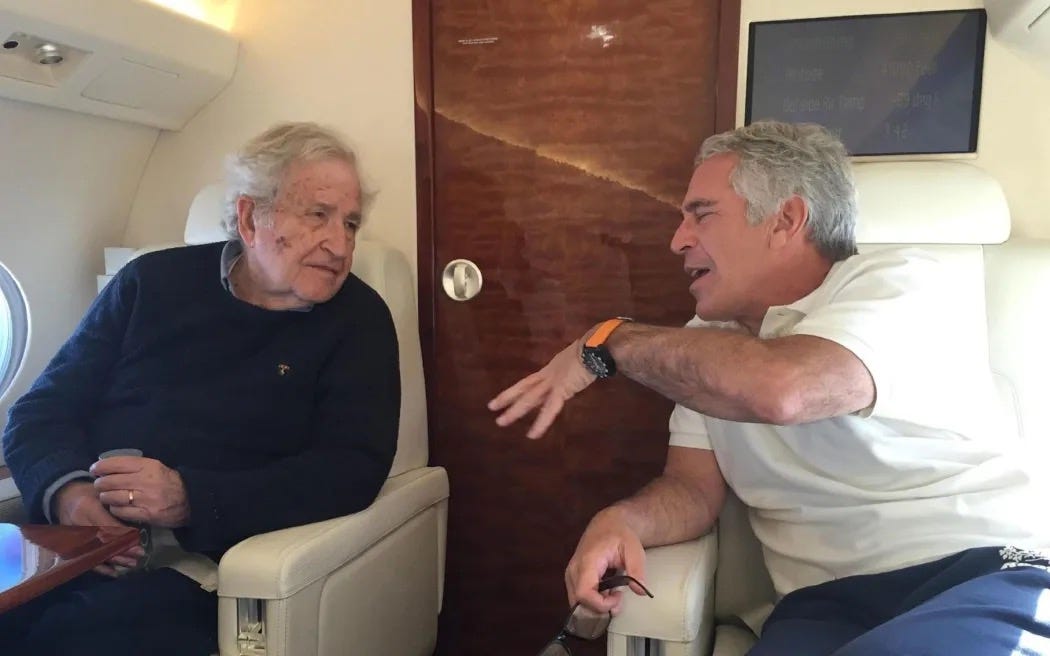
[NOTE: This is not a detailed account of Chomsky’s relationship with Epstein and not really about Epstein at all. For excellent commentary on these affairs, I highly recommend the writing of Cryn Johannsen, start here.]
Learning of Chomsky’s relationship with Epstein was a grieving process. For some in academia and on the left this is an unintelligible response because we ought to have no heroes, we ought to always expect the worst, or because they had no real connection to his intellectual career. This grieving process ended fairly quickly with my acceptance that he had at minimum acted reprehensibly—the jury is still out on complicity with actual criminal activity, but for someone whose entire public identity centered around the “responsibility of public intellectuals,” his behavior was morally repugnant.
In order to understand why this resulted in grief,something of an intellectual autobiography is in order. Without getting too in the weeds of my life, anyone who has known me has known that a salient feature of the arc of my life has been poverty. I am a proletarian intellectual who has found himself inhabiting spaces that are adjacent to the elite for some time. My early life was much like this as well. I was raised by a perennially broke elementary school teacher yet dependent on an estranged parent who always had a considerable amount of money, local elite status, who eventually got to ring the opening bell of the New York Stock Exchange when their company went public. I watched our physical home deteriorate around us as we could not afford basic repairs even as other family lived in actual mansions. I was forced to attend a private school for rich people in my county whose origin was—you guessed it—as a counter to desegregation policies in the 60s and 70s. I and a handful of other students had the “privilege” of being the poor kids amongst a sea of the rich.
It is no wonder then that I eventually turned to socialism, because the basic fact of my life has been, from a very young age, the cruel realization that moral goodness and financial power are completely divorced from one another. Furthermore, I learned early on that the people screaming the loudest about moral responsibility are the ones swimming in wealth while watching their neighbors and loved ones drown in debt and unnecessary misery. Unearned status has surrounded me for my entire life.
My earliest “rebellion” was a version of “doing what is allowed”: I became a sincere Christian. The people around me insisted that the problem with the world was that “prayer was taken out of schools” and “Christ was taken out of Christmas.” So I dove into that world. I read the sixty six books of the Bible in multiple translations and learned the texts that were held up by the adults around me as sacred by heart. I quickly learned my lesson. Nowhere in the texts did I find a justification for racism, but racial ideology was something that none of these people would budge on. They would argue day and night that we needed “a Christian worldview,” but somehow that meant something like Jim Crow. Nationalism was the next issue that baffled me. I had learned about the cosmopolitan nature of the church, of its global nature, of the little “c” catholic nature of authentic Christianity, only to see inane cruelty expressed by these supposed Christians about “foreigners” and “illegals.” Flattening other countries with military might was, astoundingly, a pious activity in their mind.
I had no connections to academia. The only socialists I had ever heard about were in history books. The only anarchists I knew about were decried in the media as criminals. The only lifeline I had to the outside world were book stores. I was obsessed with reading. I would get up hours before dawn to read Homer, Dante, and Milton. And one day I saw a book at the bookstore titled Hegemony or Survival: America’s Quest for Global Dominance, by Noam Chomsky. I devoured it. Suddenly I could make sense of what was happening with the looming invasion of Iraq, of the insane post-9/11 group think that surrounded me. Family members reacted with horror after I published an article in the school newspaper decrying the horrors of US foreign policy. One purchased David Horowitz’s shameful book listing “dangerous” American academics as well as a book that was specifically “anti-Chomsky” in its content. Of course, because these people don’t read, they never made it through either, but this was the level of panic that the name of Noam Chomsky brought into my life.
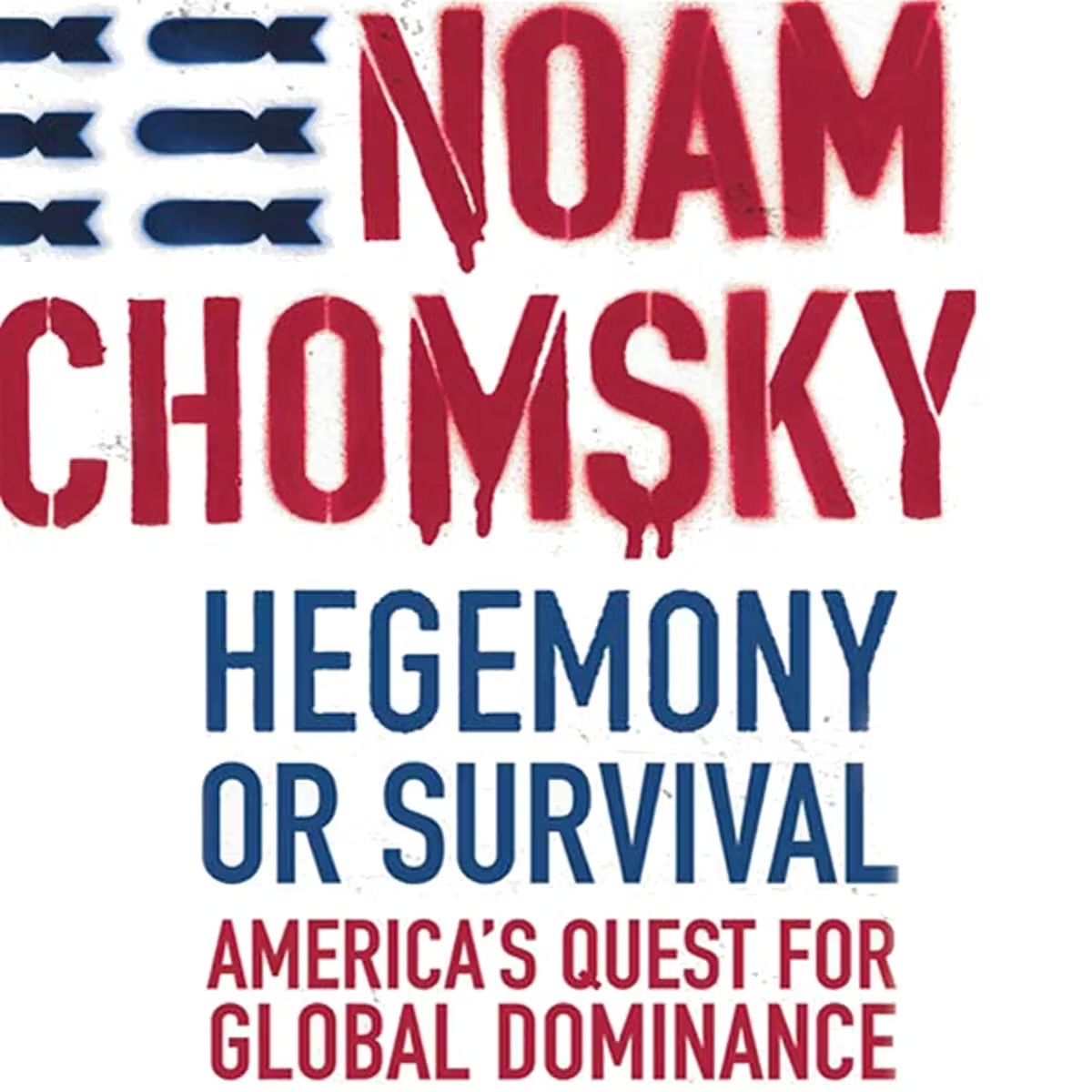
After that came several more Chomsky books. My wonderment of the callousness with which Palestinian Christians were treated by conservative American Christians was suddenly the impetus for reading the reporting of Amira Hass. I picked up Howard Zinn. I started watching Amy Goodman on Democracy Now. The world opened up to me. When I entered academia, I learned that much of what I had been brought up to understand as the basics of the world around me was totalitarian propaganda. This activated an activist career that continues to this day.
Throughout this, I have been poor. I dropped out of undergraduate studies due to an abusive relationship and a lack of funds. My mental health has been chaotic, to say the least. I have struggled for every inch that I’ve gained in academic life. I ended up graduating with an insane 60 credit hours in Philosophy because I could not stop taking the classes. I was published at multiple leftist outlets and even got an essay into a book on popular culture before beginning my graduate school career.
Throughout this period I had a sort of North Star that was, in retrospect, a product of my parochial beginnings. I wanted to go to the New School for Social Research for graduate study in Philosophy. It had long been represented to me as the place where the academic left’s conversations were happening. To pass over an incredibly long and fraught story—I made it! But with astronomical debt. And I learned again the lesson I had in my previous schooling: I was the poorest student around.
I would never give up my experiences at the New School, yet what stands out the most is the alienating realization that most of my colleagues’ money problems were of a different kind than mine. When they said they were broke they meant something different from what I meant. In a class on Marx, as we discussed the pernicious effects of impoverishment, I said, “I doubt anyone in here besides me has ever stolen food to survive.” The response was somewhat immediate and dramatic: of course no one had been in that position. Once, when detailing in a professionally written e-mail how I was falling behind in my research because I had been told to expect a certain scholarship that simply disappeared, someone responded, “I am tired of hearing about your money problems.” This is someone I know for a fact has not struggled financially since perhaps the 1980s—if at all—and who purportedly represents the views of a left wing anarchist.
Which brings me back to Chomsky. I had mostly left Chomsky behind by 2007 or 2008. I didn’t need his analysis anymore, I grew past it. But it was a life raft. I road it to the shoreline where I met numerous other intellectuals who guided me through the darkness and helped me unlearn much of what I had learned. Yet the simple fact is Noam Chomsky’s books appeared in the bookstore because he was a wealthy elite figure. Full stop. His name recognition was a result of the social circles of elite academia related to MIT that he circulated through. I might have learned something from him, but he was not a comrade like other academics I had met. He was not like the wonderful professors at the New School who, in spite of their status, looked after me, helped me, went to bat for me, and did what they could to bring a working class philosopher into a different and better world.
Instead, Chomsky was like those academics I had met in New York who were in just as much of a bubble as I had been in as a young evangelical Christian in the American South. These figures talk about socialism and class struggle in very abstract terms. I commend them for at least doing that. They ought to. But they haven’t felt what it is like to go to bed hungry. They haven’t had to steal their philosophical conversations in between pizza deliveries, where I and another avid philosophy student would chain smoke and furiously debate everything from the meaning of Anaximander’s apeiron to the wisdom of trying to replicate the Leninist Party in current conditions. None of these figures have had to wonder if they were going to see their child for Christmas this year because they could not afford the plane ticket, nor did they have to sacrifice their health and well-being just to ensure their child got to school on time and was fed properly in body and soul—only to find themselves still behind on rent, bills, and facing eviction.
So I’m not surprised about Chomsky anymore. I knew better, I just did not want to admit what I knew. The class struggle is real to me because I breathe it. The class struggle is real to someone like Chomsky because they are the beneficiaries of the winning side. We are not the same.
For reporting which centers the survivors of Epstein’s